|
O'Donnell on Beckett
'The Beckett on Film project had rules,' says Damien O'Donnell. 'We weren't allowed to change the text, or the staging of the play, so we were working within fairly tight restrictions. So what I had to do was to keep constantly reading the play and finding clues in it to what I could do or how far I could push it.
'For example, there is no set in the original play, but I argued that the whole play is about power and the abuse of power, and how information is power, so we used the library as a metaphor for somebody who has control of all the power and all the information. 'With Beckett, you have to work within the restrictions he's given you, and such restrictions are actually quite liberating. People who interpret Beckett have to find a different angle within that restricted environment. And if you go for it, you'll find something that's quite novel.
'I've learned by having to obey what's on the page. Filmmakers usually write one film, shoot another and edit yet another. You can't do this with Beckett, so you have to look at it in a completely different way. It's a good discipline. So this has been an education in respecting the text and working with text. It's an unusual experience for a filmmaker. Although, interestingly, when Beckett directed What Where himself, he did edit the text, so there are several versions around.
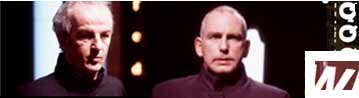
'When it came to casting, I was looking for a particular type of actor - somebody who could bring a sort of menacing quality to the screen. There is a lot of menace in the play. What Where is about a brooding, palpable evil, which is theme that occurs in Beckett's other work.
view video clip
'Filming allows you to have close-ups of the performers and you can see the fear on people's faces, which on stage you can't really get.
Back to top
|