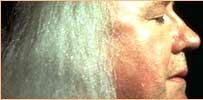
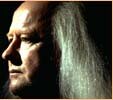
'That Time is about a man at the end of his life being bombarded by information being given to him by three different versions of his own voice, charting the course of his own life,' says Charles Garrad. 'It's about the relationship between memory and imagination, the crossover when things that one actually remembers are confused with things that may or may not have happened the nebulous nature of past experience.
'What I did was try and interpret Beckett's stage directions for film. This is the most amazingly static piece you could imagine in the theatre. It's a man's head suspended in the middle of the stage. He doesn't speak and his eyes shut three times. Then he opens them. The voices come three times: one from the left, one from the right, one from above, and they constantly interrupt each other. Immediately we begin to understand that they are his voices.
'What I did was take the three voices as three different points of view. On the stage you can easily place the voices, but in the film you look from one position and then another, and finally another. They are constantly interrupting each other.
view video clip
'The piece has no punctuation at all and is therefore open to interpretation. The voices are supposed to be a continuous flow of language. The voice therefore continues while the camera positions change.
'Niall Buggy, the actor, performed all the voices beforehand. He recorded them in blocks, with different intonations, and we edited them together. Then he performed to playback, reacting to the voices as they came back at him. Though his face is fundamentally static, he was responding emotionally.
'It was very important to maintain the notion of a continuous performance. If we had faked it, cut it together like a pop video, it wouldn't have been such a convincing performance.
'The way Beckett describes things seems to be very close to the way that we actually experience things. This play is like going on a long train journey and trying to work something out in your head. It's the same set of events repeated and changed, so you're never sure whether it is something that he remembers, something he would have liked to have happened, or something he feared might have happened. They are all combined and reiterated again and again.
'The choice of camera movements and the changes in picture size are subjective responses to the text. Audiences have said that they were able to see the thoughts in [the Listener's] mind as they watched, and I hope this is the reaction that we have managed to provoke with the film.'
Back to top