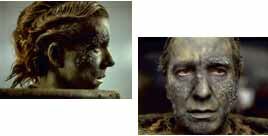
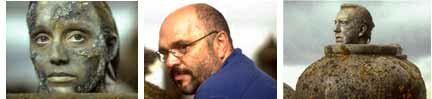
'When I was young, I was the worst kind of Beckett anorak,' admits Anthony Minghella. 'I went to university in 1972 and discovered Beckett the second I arrived. The following four or five years of my life were defined by that discovery in some ways. I became obsessed with the writing its mixture of austerity and romance. It's like Bach for me the two major discoveries in my young adulthood were Bach and Beckett. For both it's true that there's this monkish, extremely rare and dry surface, underneath which there is a volcano.
'My unfinished doctoral thesis was on Beckett. Play was the first play I ever directed, in a double bill with Happy Days. There was a time, for five years, when I read Beckett almost on a daily basis. The sense of language and poetry in his writing has been the single biggest influence on me as a writer.
'The way I've been working with actors on this project is antithetical to everything I believe in. I don't believe in the martinet conductor/director. But in this, I find myself invading the process and trying to annihilate psychology, annihilate the organic creation of the moment. It's not about that it's a score in some way. And we're all hostage to it.
'If you are making a film of Play, you have to find a cinematic correlative to the light, which the stage directions specify for every speech otherwise you are just filming a live performance. You can't have a light moving and a camera moving one has to be still.
view video clip
'When I was teaching dramatic literature, I would say to students: Look at the last page of Beckett's Play and the stage direction 'Repeat play'. There's no way you can experience that on the page. In a novel or poem you can experience the whole thing in your relationship to what's written, but in the theatre or on film it's about the experience of time, and time is very different when you're sitting in front of the play twice. And obviously the Dantesque idea of his is that in purgatory we'll be forced to revisit the same trivial pieces of our lives again and again, in a kind of ironic version of life.
'The great thing about movies is that the method of constructing film is by repetition, by takes, taking one element and doing it again and again until you've got it right, which is essentially what the characters in Play are doing: they're doing things again and again until they think they've got it right and can therefore move on. I am not just going to repeat the same piece of film twice. The repeat will be a different version of the same words. The text remains exactly as it's written, but I'm looking to get a layered quality to the film, not just pressing the rewind button. I'm trying to find a film correlative to actors repeating the piece twice.
view video clip
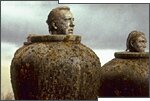
'It's bleak, but what I think is healing in Beckett is laughter. There's huge amount of farce in his work. It's a farce in repetition first time round, you laugh, and next time round it's harder to laugh. I assume if it kept repeating it would get more and more terrifying. When the actors have been trapped in urns for two or three days, you start to get the claustrophobia, you start to get terrified. Insects and flies get in and start irritating the actors and you realise that the idea of this is incredibly cruel and remorseless. I think the healing gradually disappeared from his writing.
'Everybody who loves Beckett will say the same thing: no matter how miserable or dark or cruel it is, it is also uplifting in an odd way because it's so honest and so true.
'In the theatre, a blackout can be used as a powerful form of punctuation, but you can't do that in film. Black in film means nothing. Instead, I've tried to use run-outs, lead-ins, fogging, clapperboards and so on for the filmic equivalent of punctuation. They are the same kind of distancing devices.
'Beckett is laughing at the characters, but on the other hand it is deeply felt. He pokes fun at them, but he also feels for them.'
Back to top