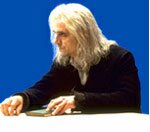
'I wanted to find a cinematic key to what is essentially a theatrical work,' says Charles Sturridge. 'I felt that there wasn't much point in making a film about a Beckett play unless you use the medium to extend the ideas of the play. This play Ohio Impromptu describes two characters whom the author wishes to be as alike as possible. Obviously, on the stage you do your best you can get two actors who are vaguely alike. But shooting a film I can have two actors completely alike Jeremy irons playing both parts.
'Film as a medium extends the idea of the play. Beckett is a remover of anything that might misdirect the audience. He takes everything out except the absolute essentials in order to produce the purest, simplest line of thought. Ohio Impromptu captures that universally human emotion of losing the one you love the most and expresses it in its purest and most terrifying form.
'I wanted to both draw the audience into the film and create this extraordinary image of a man talking to himself. I particularly wanted to literally encircle the action to wholly convince the eye that there were two palpable beings, who were separate entities, who at the end of the piece become the same. Hence the complicated physical technique of remote-control camera, which is a machine-driven camera which can effortlessly replicate its movements, so that you can shoot both actors with exactly the same movement. If you have a still camera, there's no problem, you can just move the actor; but in this instance, I wanted the camera to literally encircle the action, to draw us into the story we are being told.
view video clip
'What happens when we use one person is that we have to rehearse more than we usually do in film, because the same actor plays both parts, and we had to synchronise his expressions. It takes a lot of effort to make something look simple and effortless. The end result should be good.
'Film often, in the nature of the process, crushes out the space for rehearsal and experimentation and demands very quick solutions to emotional and physical problems. Here, we're very pared down: we have a bare table, two people and a book. What is enjoyable for me is that this is a piece of cinema. It's using a theatrical idea and taking it into a cinematic dimension.
'What is perhaps almost novelistic in a sense about a Beckett play is that it's so clear what he wants to achieve. One may say that the novelist espouses exactly what the character looks like, how the character is going to say the lines and whatever fills the whole world, whereas often the playwright leaves space for the actor to elaborate, invent, embroider. But it's very clear that Beckett doesn't want that to happen. He was being not pedantic but absolutely, perfectly clear: a kind of crystalline process.
'What surprised me was the emotion it engendered, its strength of feeling. I was prepared for something challenging, but not for the passion of his work. It's very powerfully emotional.'
Back to top