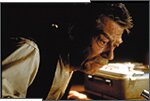
'There's a certain apprehension about bringing a piece to the screen, especially if you've done something successfully on the stage,' says John Hurt. 'On the other hand, it's one of the plays which does seem natural to film, if you can find a way of giving it the presence on screen, which is a two-dimensional medium a different way of keeping an audience's attention. It's the most obviously filmic piece insofar as it's quite naturalistic in a way, it's not formalised or stylised, not a modernist play in that sense. Everything that is said is perfectly reasonable. It's all in real time. If the camera behaves like an audience, as just an observer, then it isn't a huge leap of the imagination to go from an audience to a lens. If anything it can be quite helpful at times, in that it can become even more intimate. But Atom Egoyan was very careful not to get into close-up too much.
'It was never a problem having a different director to the stage production because I got on with Atom and he got on with me. There was a certain friction at the beginning because Atom wasn't used to doing a piece that he didn't work on from conception, and I was quite possessive about the play from my point of view. The frictions were worked out very quickly though, which is something you have to do very quickly. Rehearsal time on screen is a luxury. I'm used to doing that and used to working with a camera. When we got into it, we really worked very well together and I think he's done it wonderfully well. It is filmic but not intrusively so. You're never aware of the camera moving. There's only one serious cut, which he felt he needed, from the tape recorder and back again. You're not aware of the camera at all.
view video clip
'Beckett loves his characters tremendously, but he is utterly without sentiment. I don't think that Krapp is an actual autobiography, but there are autobiographical pieces in it, things taken from his life. It's about your perception of how you reconstruct your own life, how you accuse your old self.
'Memory and regret is universal. How many times in one day do you hear people say "if only" or "only if" those two words that should never go together in the English language. You think: "I could have been so much this if I'd done that if I'd played things differently." In other words, saying: "If I wasn't the person I was at the time making those decisions." But that, of course, is what you were and that is what you are now. It's something that is universal. This goes some way to explaining the spell that the play has on an audience, because it so acutely touches that point in everybody. We examine ourselves constantly.
'I have an ability, particularly on stage, to appear like Beckett. There's a kind of similarity in the build of face. But nobody can look exactly like Beckett. His face was a work of art! On stage you can give the impression of a bird of prey, which is what I did. It is harder, obviously, on film.
'The long, 14-minute takes that we used are a matter of expedience. The fact that I have played it does mean that the words are part of my DNA now. I don't have to worry about remembering the lines. Usually in film you do have to worry, because it is not rehearsed until the day of shooting. I am a great believer in rehearsing film, particularly films which deal with scenes played between characters.
'Beckett may or may not have been right about the world, but he was right about his world. He was certainly right about Krapp's world. It's a common misconception that Beckett is a gloomy old bastard that he is negative and makes you despondent and depressed. I don't think that's the case at all. Most of the audiences that saw me play Krapp live on the London stage didn't react like that at all. They found it quite uplifting. It's uplifting because the emotions are real, and instead of being parochial he's chosen to write about universal things, and humanity's universal attributes. What he does so brilliantly is to take a universal understanding of a character and then make that seem to be parochial. It's a great trick, because it is therefore understandable to anybody.'