Egoyan on Beckett
'I started as a playwright and Beckett was one of my major inspirations,' says Atom Egoyan. 'And this play in particular, Krapp's Last Tape, had a huge effect on me as a teenager. It changed my whole view about how people react to technology, and how technology affects how we react to each other and to memory how the way we record our past affects how we live in the present. The play has also had a big effect on the performance art and art installations that we see today. More and more people, for example, use video in art.
'I am fascinated by human interaction with technology. Beckett explores the contrast between memory and recorded memory as Krapp reminisces on his 69th birthday, struggling to reconcile perception and reality. Technology is an enormous issue today, so Beckett's themes are hugely relevant. The human inability to communicate in reality is brought into sharp focus.
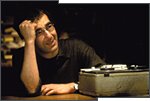
'Filming the play adds another layer. We are making a recording of a play about a man recording his life. I wanted to integrate all that into the language of the film. To do this, we used very long takes, during which you become aware of time, and not using a lot of cutting.
'At one point, there's even a shot in which the camera is rolling along following him listening to the recording, and then he stops, and then it's rewound and the camera moves back. Although this sounds very obvious, I think it's an example of how the camera can contain another spirit. There a man interacting with a spirit captured on tape and the camera can almost become a character as well. The camera doesn't just record the performance, it participates in it.
view video clip
'Beckett is directing me from the grave & I do communicate with him every night. Actually, this is the definitive production because he's telling me what to do that's the sort of influence he's had on me. Regularly, all the time. This isn't really me. For a number of days I've been Samuel Beckett.
'Some days, I think he's absolutely right about the world and other days I think that he had a particular take on the world. I think that what he was right about, though, is that we are condemned to suffer if we look too closely and we are also condemned to suffer if we don't look at all. It's that paradox within his work and that's what makes him essential.'
Back to top